Writing practice
Kanji Stroke Order: Rules, Animated Examples & Practice
Kanji stroke order is the sequence and direction used to write a character. Start with common patterns: top to bottom, left to right, and closing an enclosure last. Explore the numbered diagrams and animations below, then try writing without the guide.
Kanji Mastery learning library · Sources and corrections
Open the writing drill →Kanji stroke order: animated examples
Follow the numbers in each diagram. Open the animation and press Animate to watch the strokes in order, then try writing the character from memory.
十 — ten
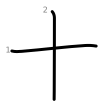
Horizontal before vertical
Draw the horizontal stroke from left to right, then the vertical stroke from top to bottom. 十 has two strokes.
Watch the animation
川 — river
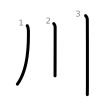
Left to right
Write the left stroke first, the middle stroke second, and the right stroke third. Each stroke moves downward. 川 has three strokes.
Watch the animation
木 — tree
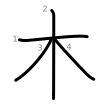
Build the centre before the sides
Write the horizontal stroke, then the central vertical. Add the left-falling stroke, then the right-falling stroke. 木 has four strokes.
Watch the animation
日 — day; sun
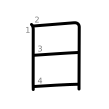
Close the enclosure last
Write the left vertical, then the top and right side as one turning stroke. Add the inner horizontal, and close the bottom last. 日 has four strokes.
Watch the animation
Diagrams by KanjiVG / Ulrich Apel, used unchanged under CC BY-SA 3.0.
Common kanji stroke-order rules
Use these patterns as a starting point. They are common conventions, not a universal algorithm: check the diagram for the specific character when the patterns conflict. A bend can be part of one continuous stroke, as in the top-right corner of 日.
| Pattern | Example | What to notice |
|---|---|---|
| Top to bottom | 三 — three | Write the top horizontal, then the middle, then the bottom. |
| Left to right | 川 — river | Write the three downward strokes in left-to-right order. |
| Horizontal before a crossing vertical | 十 — ten | Horizontal first; vertical second. |
| Centre before diagonal sides | 木 — tree | After the horizontal and vertical, write the left and right diagonals. |
| Close an enclosure last | 日 — day; sun | Write the inside horizontal before the bottom closing stroke. |
Learn patterns, not thousands of isolated diagrams
Many characters reuse the same components. Once a component has a stable stroke sequence, you can carry that movement into more complex kanji. This reduces the amount of new motor information in each character and makes visual differences easier to notice.
Common tendencies include writing from top to bottom and left to right, completing a left-side component before moving to the right, and closing an enclosing shape after writing what belongs inside it. These tendencies have exceptions, so use an authoritative diagram when learning a new form.
Use four passes for a new character
First watch the complete sequence without drawing. Second, trace slowly while naming useful landmarks such as the left component or enclosure. Third, copy the character beside the guide. Fourth, hide the guide and write it from memory.
The last pass is essential. Tracing can feel fluent because the path is visible, but it does not prove that you can produce the form. Compare your attempt with the model and choose one correction—proportion, missing stroke, direction, or order—for the next attempt.
- Watch once to understand the overall movement.
- Trace once or twice to feel the sequence.
- Copy while looking, paying attention to proportions.
- Write from memory and compare with the guide.
Accuracy before speed
Writing quickly too early hides uncertainty. Begin large enough to see each component clearly, then reduce the size after the sequence is stable. A correct but hesitant character is a better starting point than a fast character with merged or missing strokes.
You do not need dozens of repetitions in one sitting. Three attentive attempts followed by a delayed test usually provide more information than filling a page while copying. Space the attempts across the day or across several review sessions.
Diagnose the kind of writing mistake
If the overall character is wrong, return to its major components. If the components are correct but badly placed, practise proportion with a square guide. If only the stroke order fails, slow down and rehearse the transition around the problem point. If you cannot begin at all, prompt with the first component rather than revealing the entire answer.
Writing practice should support your actual goal. Learners focused mainly on reading can use a small amount of handwriting to strengthen visual memory; learners who need handwriting should test production regularly and keep separate track of writing accuracy.
Check your understanding
Say or write your answer before opening the explanation. Revisit the relevant example if you miss a question.
1. Which stroke comes first in 十?
Show answer and explanation
The horizontal stroke, moving from left to right.
The crossing vertical comes second. This example follows the common horizontal-before-vertical pattern.
2. Is the top-right corner of 日 two separate strokes?
Show answer and explanation
No. The top horizontal and right vertical form one turning stroke.
日 has four strokes: left vertical, top-right turning stroke, inner horizontal, and bottom horizontal.
3. Which stroke closes 日, and when do you write it?
Show answer and explanation
The bottom horizontal closes the shape and is written last.
Write the inner horizontal before closing the enclosure. This makes the inside-before-closing pattern visible.
Explore the characters in this lesson
Put it into practice
Pick one level and trace each character once. Then hide the guide and write the same character from memory before continuing.
Open the writing drill